
What an imported bean really costs


Sara, who keeps the numbers, has the other bills.
Freight was ₹4,800. The clearing agent, ₹4,200. That's ₹9,000 on top of the beans.


Then the beans cost more than ₹900 a kilo. First, how ERPNext values stock.

Every kilo in stock has a value: what it cost you. ERPNext calls it the valuation rate.
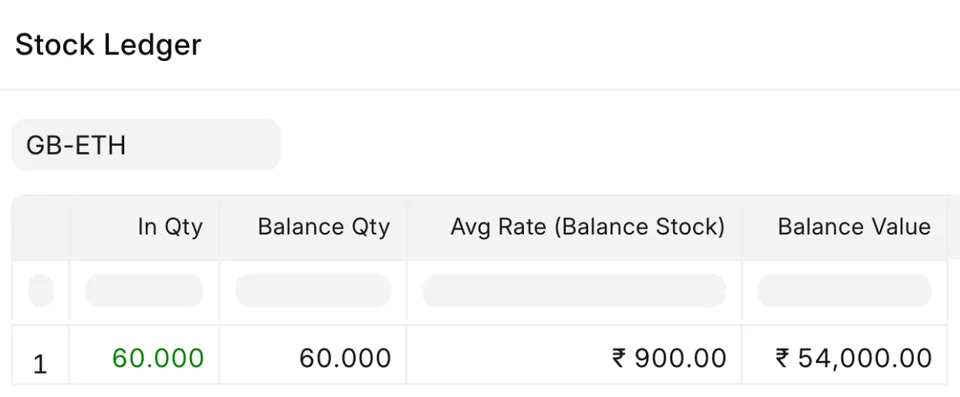
The report's average rate is the valuation rate: ₹900 a kilo, so 60 kg are worth ₹54,000. The freight isn't in it.

Salman, who designs the bags, shrugs.
Does it matter? The money's spent either way.


Leave it out and every roasted bag looks cheaper than it is, and its profit looks bigger than it is.

So how do I add it?
With a Landed Cost Voucher. You attach the charges to the Purchase Receipt they belong to.
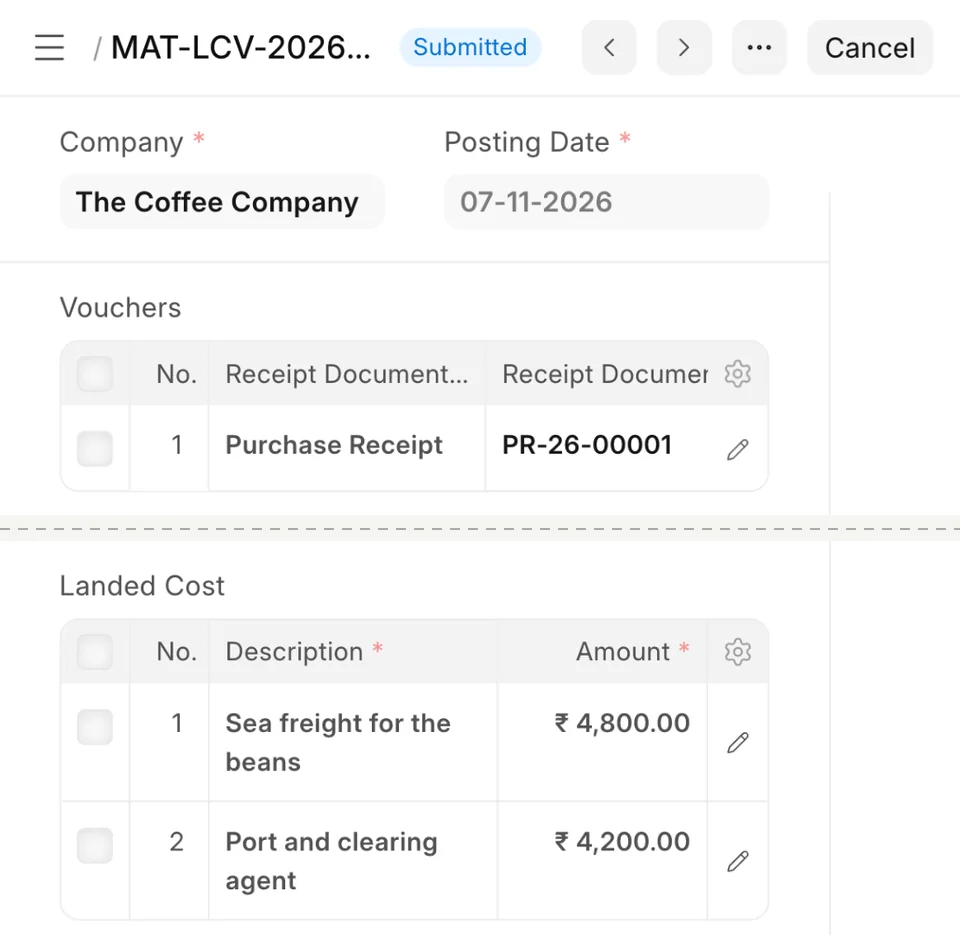
Sara's Landed Cost Voucher: sea freight ₹4,800 and the clearing agent ₹4,200, against Highland's receipt, split by quantity.

Split how, if one delivery has two kinds of beans?
You choose: by quantity, by amount, or by hand.
Submitted. The same 60 kg are now worth ₹63,000: ₹1,050 a kilo. ERPNext updated the receipt's value itself.
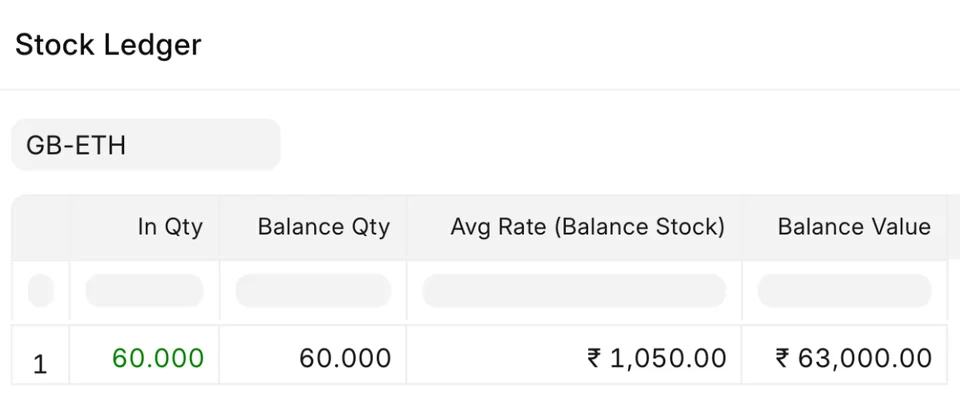
₹54,000 plus ₹9,000 is ₹63,000. Over 60 kg, that's ₹1,050 a kilo.


Now that number I believe.
Record the roasting in ERPNext and every bag made from these beans carries it. That's ERPNext II.
Any catch?
Book freight as a plain expense and the stock never knows. Attach it to the receipt.
ERPNext I, in one box: what ERPNext does for buying and selling, how, and what comes later.


Ishita has followed every step.
Buying and selling: yes. And what happens to the beans once they're here?
Add freight and clearing to the beans with a Landed Cost Voucher, so every bag carries its real cost.
SOURCES
- docs.frappe.io/erpnext/stock-transactions-landed-cost-voucher
- docs.frappe.io/erpnext/fifo-and-moving-average
- docs.frappe.io/erpnext/sales-order
- docs.frappe.io/erpnext/price-lists
- docs.frappe.io/erpnext/customer-group
- docs.frappe.io/erpnext/pricing-rule
- docs.frappe.io/erpnext/material-request
- docs.frappe.io/erpnext/buying-settings
Read the comic as text
Sara, who keeps the numbers, has the other bills.
Sara: Freight was ₹4,800. The clearing agent, ₹4,200. That's ₹9,000 on top of the beans.
The Frappe Guy: Then the beans cost more than ₹900 a kilo. First, how ERPNext values stock.
The Frappe Guy: Every kilo in stock has a value: what it cost you. ERPNext calls it the valuation rate.
The report's average rate is the valuation rate: ₹900 a kilo, so 60 kg are worth ₹54,000. The freight isn't in it.
Screen: Stock Ledger for GB-ETH: in quantity 60, balance quantity 60, average rate ₹900, balance value ₹54,000.
Salman, who designs the bags, shrugs.
Salman: Does it matter? The money's spent either way.
The Frappe Guy: Leave it out and every roasted bag looks cheaper than it is, and its profit looks bigger than it is.
Sara: So how do I add it?
The Frappe Guy: With a Landed Cost Voucher. You attach the charges to the Purchase Receipt they belong to.
Sara's Landed Cost Voucher: sea freight ₹4,800 and the clearing agent ₹4,200, against Highland's receipt, split by quantity.
Screen: Landed Cost Voucher, submitted, dated 07-11-2026, for Purchase Receipt PR-26-00001, with charges Sea freight for the beans ₹4,800 and Port and clearing agent ₹4,200, distributed based on Qty.
Salman: Split how, if one delivery has two kinds of beans?
The Frappe Guy: You choose: by quantity, by amount, or by hand.
Submitted. The same 60 kg are now worth ₹63,000: ₹1,050 a kilo. ERPNext updated the receipt's value itself.
Screen: Stock Ledger for GB-ETH after the Landed Cost Voucher: in quantity 60, balance quantity 60, average rate ₹1,050, balance value ₹63,000.
₹54,000 plus ₹9,000 is ₹63,000. Over 60 kg, that's ₹1,050 a kilo.
Beans: 60 kg, ₹54,000.
Freight: ₹4,800.
Clearing agent: ₹4,200.
= Real cost: ₹1,050 a kilo.
Sara: Now that number I believe.
The Frappe Guy: Record the roasting in ERPNext and every bag made from these beans carries it. That's ERPNext II.
Sara: Any catch?
The Frappe Guy: Book freight as a plain expense and the stock never knows. Attach it to the receipt.
ERPNext I, in one box: what ERPNext does for buying and selling, how, and what comes later.
Quote to payment: Built in.
Cafe and online prices: Built in.
Big-order discounts: Built in.
Request to payment: Built in.
Freight in bean cost: Built in.
Compulsory buying steps: A setting.
GST on invoices: In ERPNext III.
Ishita has followed every step.
Ishita: Buying and selling: yes. And what happens to the beans once they're here?
Get the next part by email
One email when a new part of the story comes out. Nothing else, and you can leave any time.
You're on the list.
If an email asks you to confirm, click the link in it. After that, every new part comes to your inbox.